
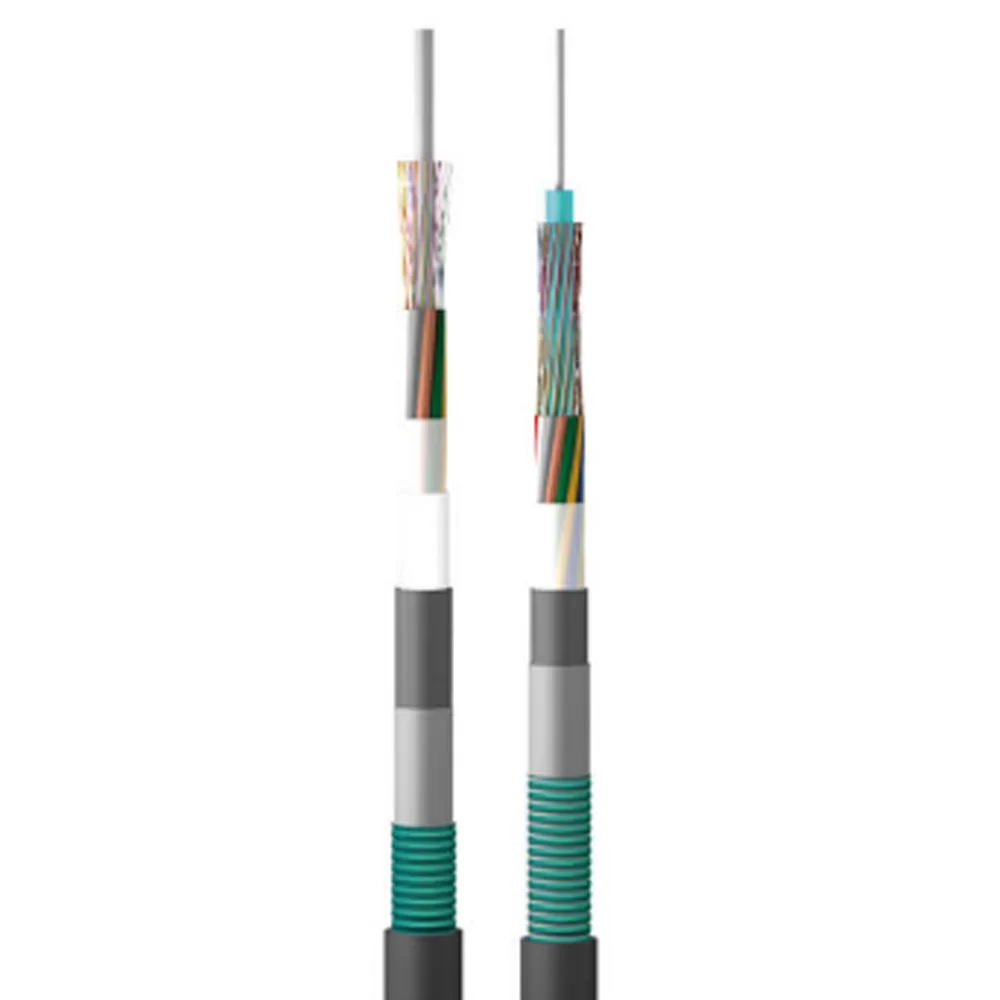
The Loose-tube Stranded Non-metallic Strength Member Armored Flame-retardant Optical Cable is designed for telecommunications networks requiring reliable optical transmission and enhanced mechanical protection. Featuring a central non-metallic strength member, stranded loose tubes, moisture barriers, steel tape armor, and a flame-retardant outer sheath, it provides protection against moisture ingress, crushing forces, and external mechanical stress.
The cable uses a fully water-blocked core structure with coated aluminum tape and double-sided coated steel tape armor. Its non-metallic central strength member helps reduce lightning-related risks and electromagnetic interference concerns along sensitive communication routes. It is suitable for duct, aerial, and direct-buried installations, depending on project conditions and applicable specifications.
Product Features
- Non-metallic Strength Member: The central FRP strength member provides structural stability while avoiding the electrical conductivity associated with metallic central members.
- Loose-tube Fiber Protection: High-strength loose tubes with water-blocking compound protect optical fibers against moisture and environmental stress.
- Enhanced Water Blocking: Water-blocking materials fill the cable core, while coated aluminum tape acts as an additional moisture barrier.
- Steel Tape Armor: Double-sided coated steel tape improves crush resistance and protects the cable against external mechanical damage.
- Flame-retardant Outer Sheath: The flame-retardant outer sheath provides an additional layer of protection for suitable installation environments.
- Stable Optical Performance: The loose-tube construction helps accommodate fiber movement caused by temperature changes and mechanical stress.
- Flexible Installation: Suitable for duct, aerial, and direct-buried applications when the installation method matches the cable specification.
- Wide Fiber Capacity Range: Available in configurations from 2 to 144 fibers to support different network capacities.
Applications
- Telecommunications backbone and access networks
- Outdoor fiber optic transmission systems
- Underground duct installations
- Aerial optical cable routes
- Direct-buried fiber optic infrastructure
- Communication routes requiring non-metallic central strength members
Optical Fiber Parameters
| Parameter | G.652 | G.655 | 50/125 μm Multimode | 62.5/125 μm Multimode |
| Attenuation at 850 nm (dB/km) | — | — | ≤3.3 | ≤3.5 |
| Attenuation at 1300 nm (dB/km) | — | — | ≤1.2 | ≤1.2 |
| Attenuation at 1310 nm (dB/km) | ≤0.35 | ≤0.40 | — | — |
| Attenuation at 1550 nm (dB/km) | ≤0.22 | ≤0.23 | — | — |
| Bandwidth at 850 nm (MHz·km) | — | — | ≥500 | ≥200 |
| Bandwidth at 1300 nm (MHz·km) | — | — | ≥500 | ≥500 |
| Numerical Aperture | — | — | 0.200 ± 0.015 | 0.275 ± 0.015 |
| Cable Cut-off Wavelength | ≤1260 nm | ≤1450 nm | — | — |
Cable Structure and Mechanical Parameters
| Cable Model | Fiber Count | Loose Tube Count | Filler Rod Count | Reference Weight (kg/km) | Tensile Load, Long-term / Short-term (N) | Crush Load, Long-term / Short-term (N/100 mm) | Bend Radius, Static / Dynamic |
| GYFTZA53-2~6Xn | 2–6 | 1 | 7 | 275 | 1000 / 3000 | 1000 / 3000 | 12.5D / 25D |
| GYFTZA53-8~12Xn | 8–12 | 2 | 6 | 275 | 1000 / 3000 | 1000 / 3000 | 12.5D / 25D |
| GYFTZA53-14~18Xn | 14–18 | 3 | 5 | 275 | 1000 / 3000 | 1000 / 3000 | 12.5D / 25D |
| GYFTZA53-20~24Xn | 20–24 | 4 | 4 | 275 | 1000 / 3000 | 1000 / 3000 | 12.5D / 25D |
| GYFTZA53-26~30Xn | 26–30 | 5 | 3 | 275 | 1000 / 3000 | 1000 / 3000 | 12.5D / 25D |
| GYFTZA53-32~36Xn | 32–36 | 6 | 2 | 275 | 1000 / 3000 | 1000 / 3000 | 12.5D / 25D |
| GYFTZA53-38~42Xn | 38–42 | 7 | 1 | 275 | 1000 / 3000 | 1000 / 3000 | 12.5D / 25D |
| GYFTZA53-44~48Xn | 44–48 | 8 | 0 | 275 | 1000 / 3000 | 1000 / 3000 | 12.5D / 25D |
| GYFTZA53-50~60Xn | 50–60 | 5 | 3 | 290 | 1000 / 3000 | 1000 / 3000 | 12.5D / 25D |
| GYFTZA53-62~72Xn | 62–72 | 6 | 2 | 290 | 1000 / 3000 | 1000 / 3000 | 12.5D / 25D |
| GYFTZA53-74~84Xn | 74–84 | 7 | 1 | 290 | 1000 / 3000 | 1000 / 3000 | 12.5D / 25D |
| GYFTZA53-86~96Xn | 86–96 | 8 | 0 | 290 | 1000 / 3000 | 1000 / 3000 | 12.5D / 25D |
| GYFTZA53-98~108Xn | 98–108 | 9 | 1 | 327 | 1000 / 3000 | 1000 / 3000 | 12.5D / 25D |
| GYFTZA53-110~120Xn | 110–120 | 10 | 0 | 327 | 1000 / 3000 | 1000 / 3000 | 12.5D / 25D |
| GYFTZA53-122~132Xn | 122–132 | 11 | 1 | 354 | 1000 / 3000 | 1000 / 3000 | 12.5D / 25D |
| GYFTZA53-134~144Xn | 134–144 | 12 | 0 | 354 | 1000 / 3000 | 1000 / 3000 | 12.5D / 25D |
Note: Xn represents the selected optical fiber type. D represents the actual cable outer diameter. Reference weight and mechanical values may vary with the final configuration. Confirm the applicable product specification before ordering.
Cable Construction
The cable uses a stranded loose-tube design built around a central fiber-reinforced plastic (FRP) strength member. Loose tubes and filler rods are arranged around the central member to form a compact, round core, with water-blocking compound filling the internal spaces.
- Central Strength Member: FRP provides non-metallic structural reinforcement.
- Loose Tubes: Protect optical fibers and provide space for movement under changing environmental conditions.
- Water-blocking Compound: Helps prevent longitudinal water migration through the cable core.
- Coated Aluminum Tape: Acts as a moisture barrier around the cable core.
- Polyethylene Inner Sheath: Adds an additional protective layer beneath the armor.
- Double-sided Coated Steel Tape: Provides armor against crushing forces and external mechanical damage.
- Flame-retardant Outer Sheath: Completes the cable structure with an additional layer of protection.
Customization Options
Configurations can be selected according to fiber capacity, optical transmission requirements, mechanical loading, and installation conditions.
- Fiber types including G.652, G.655, and supported multimode options
- Fiber counts from 2 to 144 cores
- Loose-tube and filler rod configurations
- Cable structure and mechanical performance requirements
- Installation requirements for duct, aerial, or direct-buried routes
Contact us with your required fiber count, installation method, and project specifications to select a suitable armored flame-retardant optical cable for your communication network.
No reviews yet. Be the first to review this product!


