
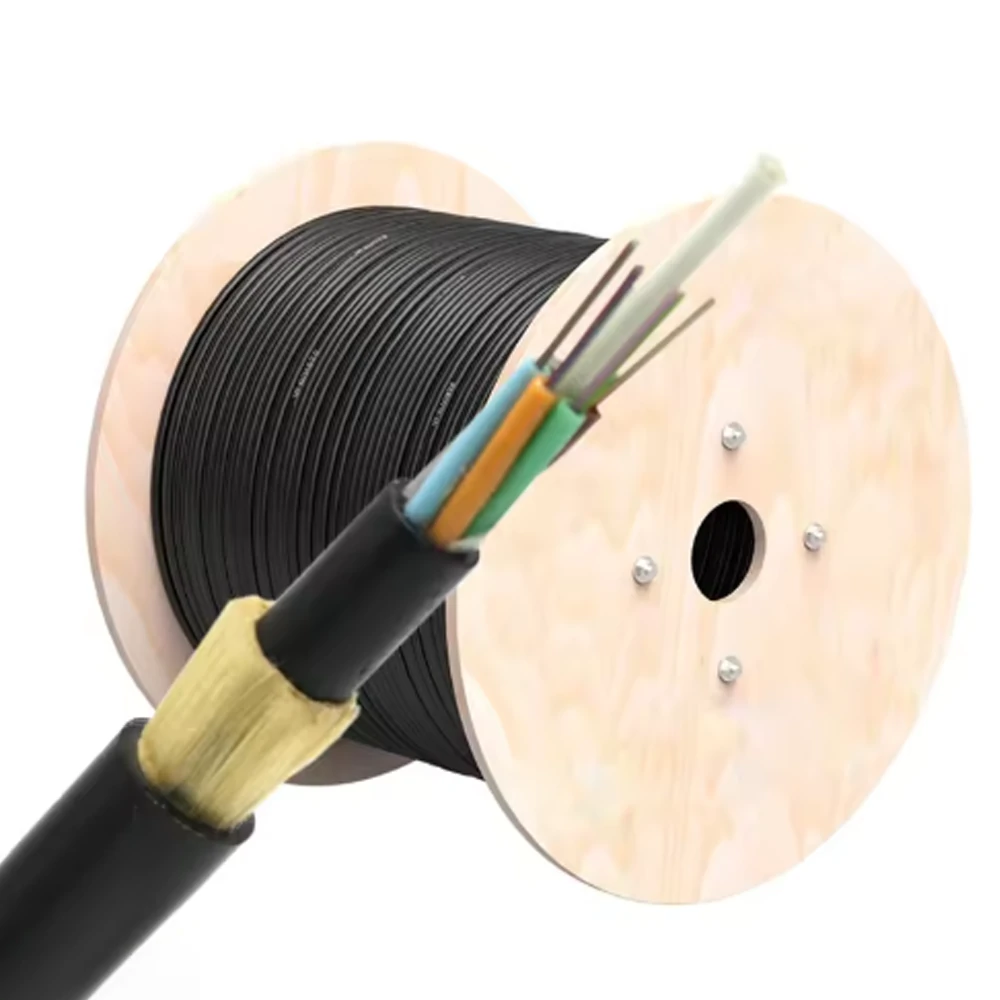
All-Dielectric Self-Supporting (ADSS) optical cable is designed for aerial fiber optic communication networks, particularly along power transmission and distribution routes. Featuring a non-metallic construction reinforced with aramid yarn, ADSS cable provides excellent tensile strength, electrical insulation, and resistance to environmental conditions. Its self-supporting design eliminates the need for a separate metallic messenger wire, making it suitable for long-span aerial installations and communication infrastructure.
Key Features
- All-Dielectric Construction: Contains no metallic conductive components, making it suitable for installation along power line routes without introducing conductive cable elements.
- Self-Supporting Design: Integrated aramid yarn strength members provide the tensile strength required for aerial installation without a separate support wire.
- Excellent Electrical Insulation: Non-metallic construction helps prevent electrical conduction through the cable.
- Anti-Tracking Outer Sheath: An optional anti-tracking (AT) sheath provides enhanced resistance to electrical tracking in environments exposed to electric fields.
- Lightweight and Compact: Small diameter and low cable weight help reduce wind and ice loading on poles, towers, and supporting structures.
- Long-Span Capability: Designed for aerial routes with different span lengths, with configurations available for spans exceeding 1,000 meters under suitable conditions.
- Water-Blocking Protection: Loose tubes filled with water-blocking compound and water-blocking materials within the cable core help prevent moisture penetration.
- Stable Optical Performance: High-modulus loose tubes protect optical fibers against mechanical stress and temperature variations.
Product Overview
The ADSS optical cable is engineered for aerial communication applications where electrical insulation, mechanical reliability, and installation efficiency are essential. Its all-dielectric structure makes it particularly suitable for fiber optic deployment on power transmission towers, distribution poles, and other overhead communication routes.
The cable uses a stranded loose-tube construction in which 250 μm optical fibers are housed in high-modulus loose tubes filled with water-blocking compound. The loose tubes and filler rods are stranded around a central fiber-reinforced plastic (FRP) strength member to form a compact cable core. Water-blocking materials fill the spaces within the core to provide additional moisture protection.
A polyethylene (PE) inner sheath covers the cable core, followed by aramid yarn strength members that provide the tensile reinforcement needed for aerial suspension. The outer sheath can be manufactured from polyethylene or anti-tracking material, depending on the electrical and environmental conditions of the installation site.
ADSS cable does not require a metallic messenger wire or grounding of metallic cable components. This simplifies the supporting structure and helps reduce installation complexity along power line routes. Its lightweight construction also helps limit additional loads caused by wind and ice.
Different cable diameters, tensile ratings, and span configurations are available to accommodate varying installation distances and environmental conditions. Selecting the appropriate cable requires consideration of span length, wind speed, ice loading, installation tension, and the electric field conditions along the route.
Technical Specifications
Optical Fiber Parameters
| Fiber Type | Attenuation at 850 nm | Attenuation at 1300 nm | Attenuation at 1310 nm | Attenuation at 1550 nm | Cable Cut-Off Wavelength |
| G.652 | — | — | ≤0.36 dB/km | ≤0.22 dB/km | ≤1260 nm |
| G.655 | — | — | ≤0.40 dB/km | ≤0.23 dB/km | ≤1450 nm |
| 50/125 μm | ≤3.3 dB/km | ≤1.2 dB/km | — | — | — |
| 62.5/125 μm | ≤3.5 dB/km | ≤1.2 dB/km | — | — | — |
Multimode Fiber Parameters
| Fiber Type | Bandwidth at 850 nm | Bandwidth at 1300 nm | Numerical Aperture |
| 50/125 μm | ≥500 MHz·km | ≥500 MHz·km | 0.200 ± 0.015 |
| 62.5/125 μm | ≥200 MHz·km | ≥500 MHz·km | 0.275 ± 0.015 |
Cable Mechanical Parameters
| Parameter | Specification |
| Cable Type | All-Dielectric Self-Supporting Optical Cable (ADSS) |
| Reference Outer Diameter | 11.8–14.8 mm |
| Reference Weight with PE Outer Sheath | 117–195 kg/km |
| Reference Weight with AT Outer Sheath | 124–204 kg/km |
| Central Strength Member | Fiber-reinforced plastic (FRP) |
| Tensile Strength Members | Aramid yarn |
| Inner Sheath | Polyethylene (PE) |
| Outer Sheath Options | Polyethylene (PE) or anti-tracking (AT) |
| Maximum Suitable Span | Can exceed 1,000 m with an appropriately designed configuration |
| Service Life | Designed for long-term service; the source specifies an expected service life exceeding 30 years |
Reference Tensile and Span Parameters
| Reference Cable Diameter | Daily Working Tension (kN) | Maximum Working Tension (kN) | Breaking Strength (kN) | Reference Suitable Span A (m) | Reference Suitable Span B (m) | Reference Suitable Span C (m) | Reference Suitable Span D (m) |
| 11.8 mm | 1.5 | 4 | 10 | 100 | 140 | 100 | — |
| 12.0 mm | 2.25 | 6 | 15 | 150 | 200 | 150 | — |
| 12.3 mm | 3.0 | 8 | 20 | 200 | 290 | 200 | — |
| 12.6 mm | 3.6 | 10 | 24 | 250 | 350 | 250 | — |
| 12.8 mm | 4.5 | 12 | 30 | 280 | 400 | 280 | — |
| 13.1 mm | 5.4 | 15 | 36 | 320 | 460 | 320 | — |
| 13.5 mm | 6.75 | 18 | 45 | 380 | 550 | 380 | — |
| 13.8 mm | 7.95 | 22 | 53 | 460 | 650 | 460 | — |
| 14.4 mm | 9.0 | 26 | 60 | 530 | 750 | 510 | — |
| 14.6 mm | 10.5 | 28 | 70 | 560 | 800 | 560 | — |
| 14.8 mm | 12.75 | 34 | 85 | 650 | 880 | 650 | — |
Note: The mechanical values above are reference data extracted from the source product page. The original table includes additional cable strength-member and weather-condition parameters. Confirm the complete technical datasheet and the corresponding span/weather-condition definitions before finalizing a cable specification.
Applications
- Aerial fiber optic communication networks
- Fiber optic deployment along power transmission and distribution lines
- Interconnection between substations and communication facilities
- Long-span overhead communication links
- Rural broadband and telecommunications infrastructure
- Projects requiring non-metallic, self-supporting optical cable
Customized ADSS Optical Cable Solutions
ADSS cable selection depends on span length, installation tension, wind and ice loading, ambient temperature, and the electrical environment of the route. Different cable diameters, strength ratings, and PE or AT outer sheath options can be selected to meet specific project requirements. Contact our team to discuss your installation conditions and obtain a suitable cable configuration.
No reviews yet. Be the first to review this product!


