
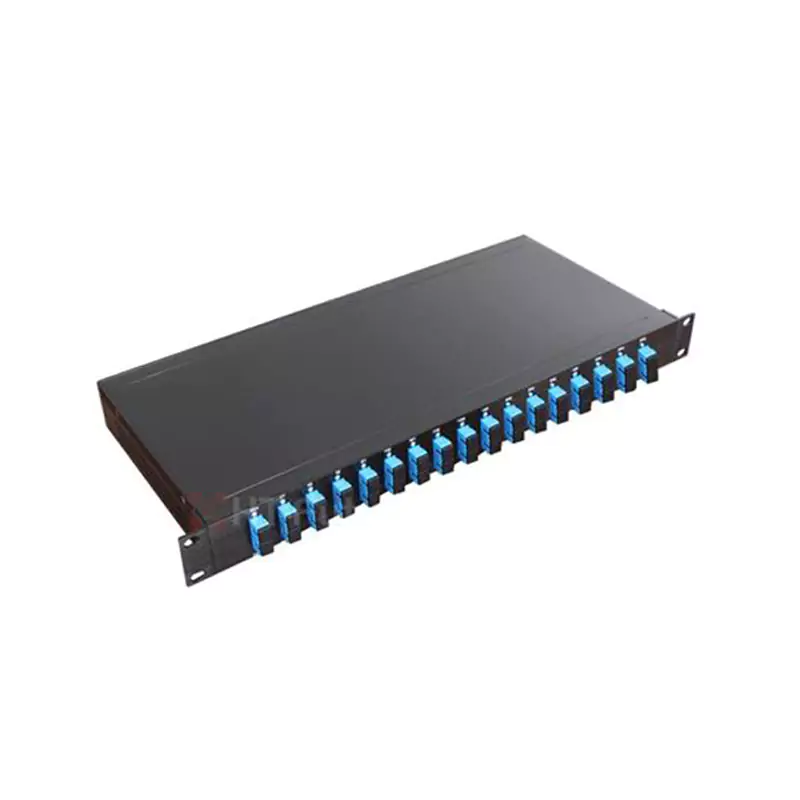
The CWDM (Coarse Wavelength Division Multiplexing) Coarse Wavelength Division Multiplexer is designed to increase fiber transmission capacity by combining multiple optical signals with different wavelengths onto a single optical fiber. At the receiving end, a demultiplexer separates these wavelengths and directs them to their corresponding receivers.
With its compact design and low insertion loss, the CWDM multiplexer is suitable for metropolitan area networks, optical access networks, and wavelength division multiplexing systems. It helps network operators make more efficient use of existing fiber infrastructure while reducing the need for additional fiber resources.
Key Features
- Increased Fiber Capacity: Transmits multiple optical signals over a single fiber using different wavelengths.
- Low Insertion Loss: Helps minimize optical power loss and maintain reliable signal transmission.
- Flexible Channel Options: Supports 2-channel, 4-channel, 8-channel, and 16-channel configurations.
- Standard Wavelength Grid: Designed in accordance with applicable ITU-T G.695 specifications.
- Low Polarization-Dependent Loss: Supports stable optical performance across different polarization conditions.
- Compact Structure: The slim package facilitates integration into optical communication equipment.
- Flexible Transmission Modes: Supports full-duplex and half-duplex applications, depending on system configuration.
Applications
- Metropolitan area networks (MAN)
- Optical access networks
- Fiber capacity expansion
- Wavelength division multiplexing systems
- Telecommunications transmission networks
- Enterprise optical communication infrastructure
- Point-to-point optical transmission systems
Technical Specifications
| Product Name | CWDM Coarse Wavelength Division Multiplexer |
| Technology | Coarse Wavelength Division Multiplexing (CWDM) |
| Standard | ITU-T G.695 |
| Channel Grid | ITU Grid |
| Channel Spacing | 20 nm |
| Channel Bandwidth | λc ± 6.5 nm (minimum) |
| Channel Flatness | ≤ 0.4 dB |
| Insertion Loss (2 Channels) | ≤ 1.6 dB |
| Insertion Loss (4 Channels) | ≤ 2.4 dB |
| Insertion Loss (8 Channels) | ≤ 2.5 dB |
| Insertion Loss (16 Channels) | ≤ 3.5 dB |
| Adjacent Channel Isolation | ≥ 30 dB |
| Non-Adjacent Channel Isolation | ≥ 45 dB |
| Insertion Loss Temperature Coefficient | ≤ 0.005 dB/°C |
| Polarization-Dependent Loss (PDL) | ≤ 0.1 dB |
| Polarization Mode Dispersion (PMD) | ≤ 0.1 ps |
| Return Loss | ≥ 45 dB |
| Directivity | ≥ 55 dB |
| Operating Temperature | 0°C to +70°C |
| Storage Temperature | -40°C to +85°C |
| Package Dimensions | 80 × 58 × 6.6 mm |
| Brand | Huijue Group |
Product Description
CWDM technology enables multiple independent optical channels to share the same fiber by assigning each signal a different wavelength. This approach is particularly useful in metropolitan and access networks where fiber resources may be limited or expensive to expand.
The CWDM multiplexer combines incoming wavelength channels into a single optical path, while the corresponding demultiplexer separates them at the destination. This allows multiple services or data streams to be carried over existing fiber infrastructure without requiring a separate fiber for every channel.
The device supports channel configurations ranging from 2 to 16 channels, making it suitable for different network capacity requirements. Its optical performance specifications, including insertion loss, channel isolation, return loss, and polarization-dependent loss, help engineers evaluate its suitability for a specific transmission link.
Configuration and Selection
When selecting a CWDM multiplexer, consider the number of required channels, operating wavelengths, optical link budget, fiber type, and compatibility with the connected optical transceivers. The selected multiplexer and demultiplexer should use matching wavelength configurations to ensure proper signal transmission.
Channel count and insertion loss should also be evaluated alongside the transmission distance and other passive components in the optical link. For systems requiring bidirectional communication, the overall wavelength plan and duplex configuration should be confirmed during network design.
No reviews yet. Be the first to review this product!


